Spotting autism early from infant EEG with deep learning
Read the paper →A clinical diagnosis of autism is usually not made until a child is three years old or older — yet the behavioural signs begin emerging in the first and second years of life, exactly when support is thought to help most. Roughly one in every 160 children worldwide is diagnosed with autism spectrum disorder. The gap between when the condition starts to take shape and when it is recognised is one of the hardest problems in developmental neuroscience. This paper asks a careful question: can a low-cost recording of an infant’s brain activity, read by a deep neural network, predict the diagnosis a child will receive years later?
The problem
Autism spectrum disorder (ASD) is a range of conditions marked by reduced social interaction, impaired communication, and a narrow scope of repetitive interests. It is defined behaviourally, not biologically — there is no blood test, no scan that settles the question. That is precisely what makes early diagnosis so hard: in the first years of life, when intervention should be most effective, the behavioural picture is variable and uncertain, and milder forms are especially difficult to detect. Even a tool that only flagged an elevated chance of emerging ASD would be valuable — it could trigger earlier, more sensitive behavioural assessments and interventions tailored to the child.
For that to work in practice, you need a measurement that is simple, low-cost, and could plausibly be implemented during routine checkups. Electroencephalography (EEG) is a strong candidate. During an EEG, electrical activity generated by brain cells is recorded through small electrodes placed on the scalp — non-invasively, at low cost, even while the subject is at rest. It has long been used to assess atypical brain function, which makes it well suited to looking for early signatures of ASD in infants.
The difficulty has been what to do with the signal. Most prior EEG work in this area focused on one-dimensional biomarkers — single summary measures extracted from the trace. These have had some success in predicting a higher chance of autism, but they fall short of high predictive accuracy and do little to identify clinical subgroups. And standard EEG analysis throws away something important: the spatial information. Each electrode sits above a particular region of the brain, with neighbouring regions around it, but conventional feature vectors ignore where on the scalp each signal came from.
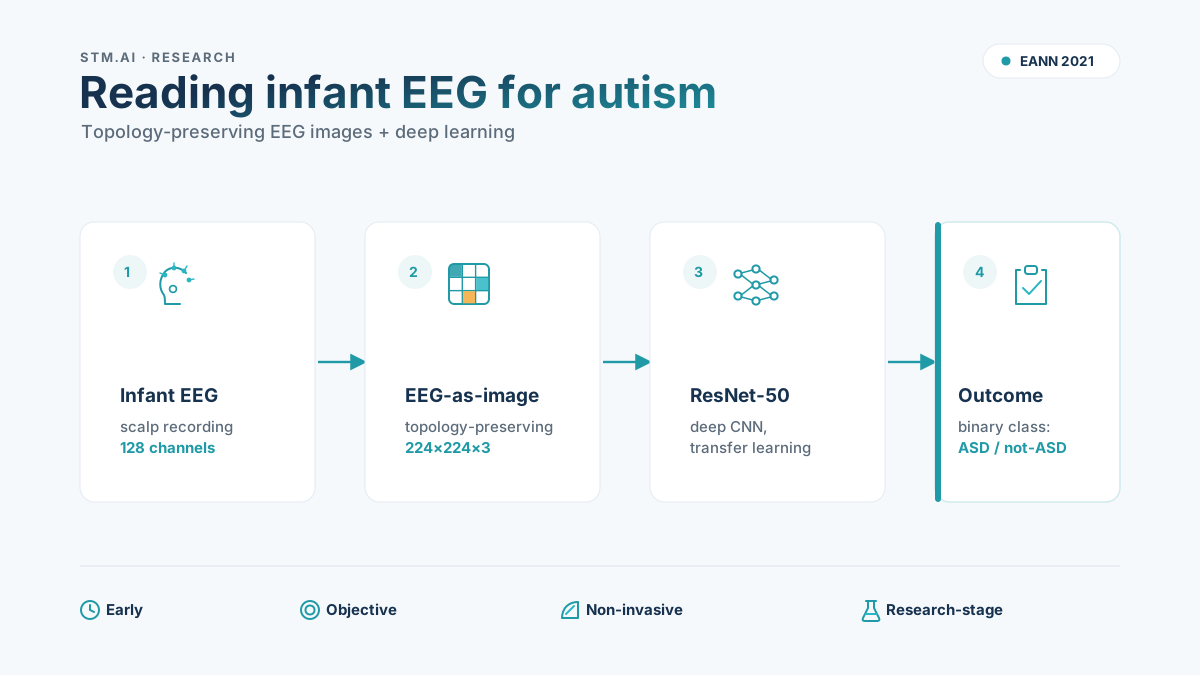
Figure 1. From scalp EEG to images a deep network can classify.
What we did
The core idea is to stop treating EEG as a list of numbers and start treating EEG as an image. Crucially, the transformation is designed to preserve the spatial, topological location of the electrodes on the scalp — so the network can learn from where activity happens, not just how much of it there is.
The pipeline works as follows. Continuous EEG was recorded with a 128-electrode net sampled at 500 Hz (116 electrodes after excluding those most contaminated by artefacts). The clean signal was cut into one-second windows, and a Fast Fourier Transform (FFT) was computed for each window across three frequency bands associated with cortical activity — Theta, Alpha, and Beta. The power in each band is then projected onto a flat map of the head using an Azimuthal Equidistant (polar) Projection borrowed from cartography, which keeps the relative distances between electrodes intact, and interpolated into a smooth 224×224 image. The three frequency bands become the three colour channels of a single RGB image. The result is a sequence of topology-preserving, multi-spectral images — in effect a short “movie” of the infant’s brain activity.
Those images are then fed to Residual Networks (ResNet) — deep convolutional networks whose “skip connections” let very deep models train without the vanishing-gradient problem that plagues ordinary deep networks. The team used a 50-layer ResNet (ResNet-50), pre-trained on the ImageNet photo dataset and then fine-tuned via transfer learning, which dramatically cut training time and outperformed training from scratch. The 1,000-class output was replaced with two outputs, turning the problem into a binary image classification: ASD versus NON-ASD. This is end-to-end deep learning — the network learns its own features directly from the images, rather than relying on hand-crafted biomarkers.
The data came from the British Autism Study of Infant Siblings (BASIS), a longitudinal cohort that follows infants at elevated family risk of autism. 101 infants took part at the 12–15-month time-point and were tracked through to 36 months of age (53 at high familial risk, 48 at low risk). Infants watched short social and non-social video clips while their EEG was recorded, and — importantly — every child received a formal clinical diagnosis only at 36 months. That diagnosis is the ground truth the model is asked to predict. Because infant EEG is exceptionally noisy (crying, fidgeting, looking away), strict artefact rejection left a relatively small, imbalanced dataset (roughly 81% NON-ASD to 19% ASD), so the team used class-balancing during sampling and early stopping to guard against over-fitting.
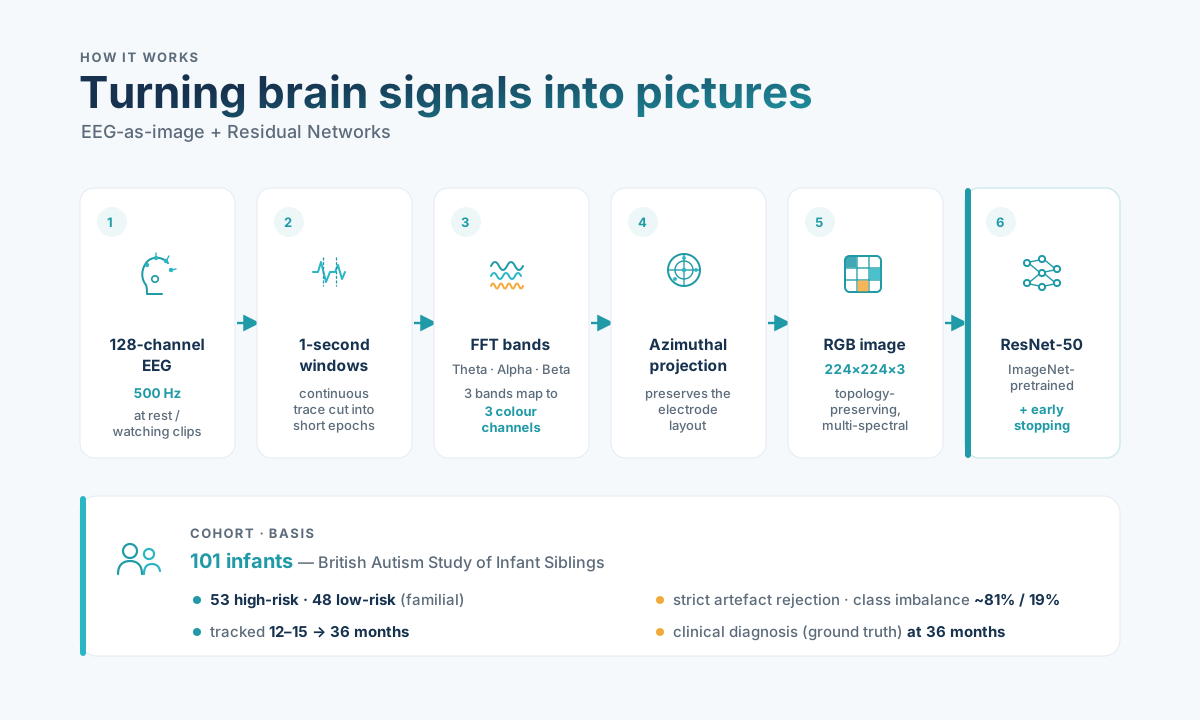
Figure 2. EEG-as-image + Residual Networks, on a longitudinal infant cohort.
What we found
The headline result is this: the model could predict the 36-month clinical diagnosis of ASD or not-ASD from EEG recorded as early as 12 months of age. In other words, the latent structure in these brain-activity images — and presumably the underlying brain processing they reflect — carries a signal about an outcome that clinicians would not confirm for another two years.
In the first evaluation, where each infant’s image windows were split 80% for training and 20% for testing, the ResNets reached roughly 78–82% test accuracy across the three video stimuli, with early stopping adding only a marginal improvement and the models showing good resilience to over-fitting. The team also ran a much stricter test — leave-one-participant-out, where all of a child’s data is held out and the model must classify someone it has never seen. Here the role of early stopping became decisive: without it, the network simply learned to predict the majority class and badly misclassified the minority ASD cases; with early stopping, performance on those ASD participants improved dramatically, with per-participant test scores rising well above the 50% threshold that marks a meaningful prediction on this binary task.
The honest caveat sits right alongside the result: this is a small cohort, with only a handful of children who went on to an ASD diagnosis, and a class imbalance the authors address with deliberate technique rather than more data. The paper presents the findings as promising evidence that end-to-end deep learning can extract useful digital biomarkers from infant EEG — not as a finished, validated test. Treating class imbalance more robustly, improving generalisation, and expanding the ASD sample are named explicitly as future work.
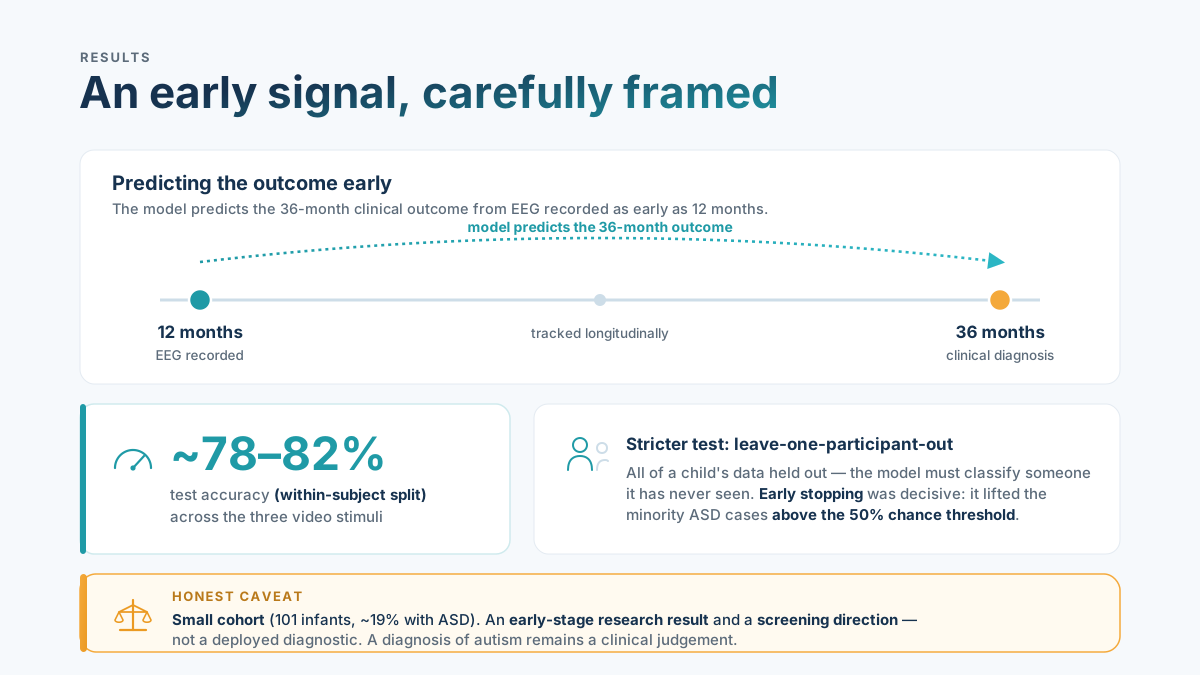
Figure 3. Early prediction of the clinical outcome.
Why it matters
The promise here is a path toward simple, early, routine digital biomarkers. If a brief, non-invasive, low-cost EEG recording — the kind that could one day fit into a checkup — carries enough signal to flag an elevated chance of emerging autism, it could help bring forward the moment when families gain access to assessment and support. That is meaningful precisely because the current diagnostic gap is measured in years.
There is also a methodological lesson. By transforming a physiological signal into a topology-preserving image and letting a deep network learn end-to-end, the approach sidesteps the limitations of hand-crafted, one-dimensional biomarkers and makes use of spatial information that standard EEG analysis discards. It is a clean demonstration that the representation you choose for a signal can matter as much as the model you run on it.
This is exactly the kind of work stm.ai’s AI-for-health practice is built around: models anchored to evidence rather than left to float free, grounded in real physiological measurements and a longitudinal clinical cohort, with a human kept in the loop by design — here, the ground truth is a clinician’s formal diagnosis, and the role any such model could play is to support assessment, not replace it. And it must be read with the same care the authors used. This is early-stage research on a small cohort, pointing in the direction of screening — a way to flag who might benefit from closer clinical attention. It is not a deployed diagnostic, and a diagnosis of autism remains a clinical judgement. In a domain this sensitive, an honest, carefully-bounded result is worth far more than an overstated one.
C. Stamate, G.D. Magoulas, M.S.C. Thomas, and the BASIS Team — “Deep Learning Topology–Preserving EEG–Based Images for Autism Detection in Infants”, Proceedings of the 22nd Engineering Applications of Neural Networks Conference (EANN 2021), Springer (2021). Read the paper.