How brain laterality shapes cognition and social ability
Read the paper →The two halves of the human brain are not interchangeable. Skilled hand movements lean on one hemisphere; reading a face for emotion leans on the other. This division of labour — lateralisation — is one of the oldest features of the vertebrate brain, far older than language or tool use. Which raises a question that is easy to ask and surprisingly hard to answer: does the way an individual brain is lateralised actually matter for everyday ability — for how well someone performs a task, picks up language, or navigates the social world? A large citizen-science study set out to test exactly that, and to do it inside a framework borrowed from the rest of the animal kingdom.
The idea
Across vertebrates — birds, fish, mammals, primates — adaptive behaviours like feeding and avoiding predators are tied to a brain divided in two. The pattern is strikingly consistent. A right-side motor bias handles skilled action sequences such as feeding, while a left-eye (left visual field) bias handles threat detection, a split thought to let an animal do two survival-critical things at once without duplicating brain machinery. Comparative research has surfaced two robust ideas from this. First, the presence and strength of an individual’s bias tends to track cognitive capacity — lateralised chicks, fish, parrots and chimpanzees are often better and faster at their tasks than weakly-lateralised peers. Second, alignment with the population majority confers a social benefit: when most individuals lean the same way, they coordinate, form stable hierarchies and read each other’s cues more easily. That second point is why populations are rarely split fifty-fifty; the common direction is theorised to be an evolutionarily stable strategy, with a minority of “reversed” individuals always preserved.
Humans clearly inherit the basic pattern: cross-culturally we are strongly right-handed for skilled motor sequences (a left-hemisphere bias) and biased to the left visual field for reading faces and emotions (a right-hemisphere bias). What was not clear is whether the two advantages seen in other animals — a cognitive boost from strong bias, a social boost from aligning with the majority — also hold in people, and whether these basic motor-sensory biases might form a foundation for higher abilities such as language. Most human laterality studies test one bias at a time, rely on complex high-level cognitive measures, and sit outside any comparative theory. This study’s central move is to bring the human question back inside the animal framework, and to measure two biases in the same people.
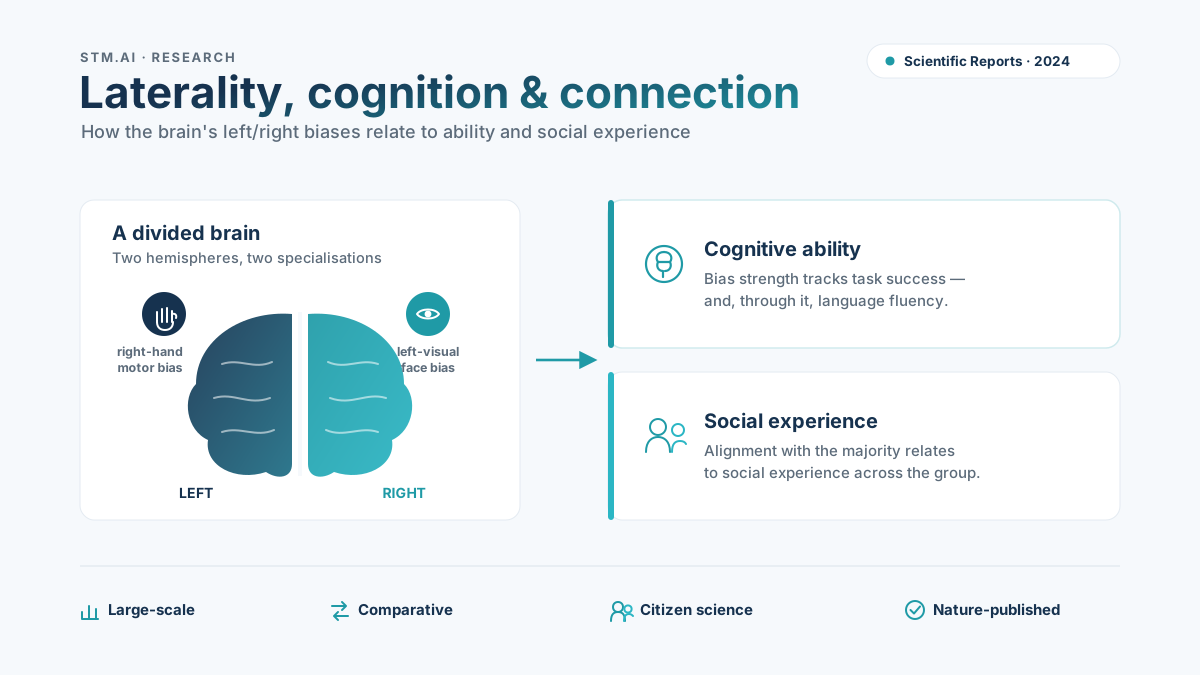
Figure 1. Motor-sensory laterality, linked to cognition and social experience.
What we measured
The data came from Me, Human, a three-month Live Science summer residency at the London Science Museum in 2019 — the same public-science project behind the team’s work on the human hand. Because visitors took part freely, with no selection criteria and a constant flow of international tourists, the sample was an unusually broad, heterogeneous cross-section of people. Depending on the measure, analyses drew on between 313 and 1,661 participants (the “walk-in” nature of the setting meant fewer people completed every task, so the within-person analyses rest on the smaller numbers). Everyone gave informed consent and completed a short demographic questionnaire, from which the team derived age, sex, maternal education, whether English was a first language, and any self-reported diagnosis of autism and/or ADHD.
Two tasks indexed the two biases, chosen deliberately to mirror the animal literature. Hand laterality — standing in for the motor-sequencing skills that underpin feeding in other species — was measured with a pegboard task: how many pegs a participant could place in one minute with each hand, tested separately. The right-minus-left difference gives the direction and strength of hand bias, while the total pegs placed gives an independent measure of motor task success. Visual laterality — standing in for threat detection — was measured with chimeric faces, composite images showing an emotional expression on one half and a neutral expression on the other; which side a person judged more expressive reveals their visual-field bias. The team also captured phonemic language fluency (a spoken task, recorded for transcription) and self-reported social difficulties via the Autism Quotient questionnaire. Combining the two biases let them sort people into laterality profiles: the ‘standard’ profile (right-hand bias and left-visual bias, mirroring the vertebrate norm) versus a ‘reversed’ profile (the mirror image), with two “crowded” profiles where both biases fall on the same side.
Turning these messy, real-world measurements into trustworthy findings is where the quantitative work sits — and where stm.ai’s Cosmin Stamate contributed, as part of a team spanning psychology, anthropology and data science. Laterality scores are notoriously non-normal, so the analyses leaned on bootstrapped confidence intervals (2,000 iterations) for the regression models and chi-square and ANCOVA tests for the group comparisons, always controlling for age, sex, maternal education and language background. To test whether moderate rather than maximal bias is best, the regressions also included a quadratic term — a small modelling choice that turned out to carry one of the study’s main findings.
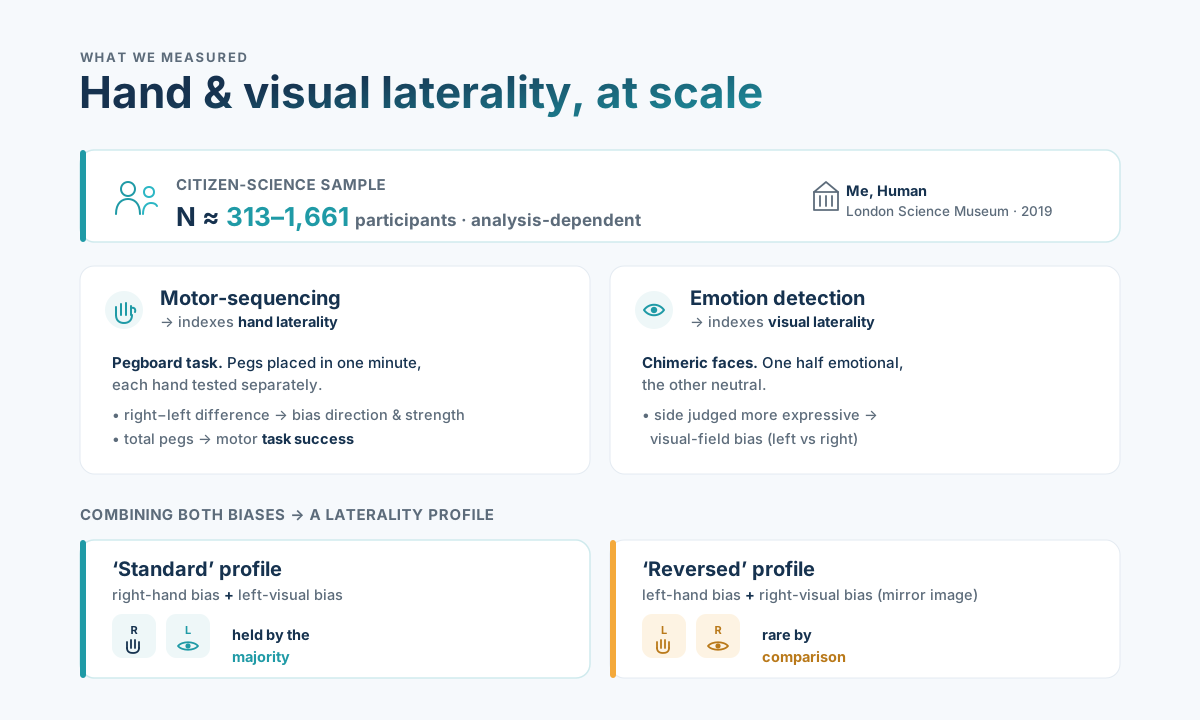
Figure 2. Measuring hand and visual laterality at scale.
What we found
First, the population biases came through clearly, exactly as the animal literature predicts. Significantly more people were right-hand dominant on the pegboard task (though the bias weakened slightly with age), and significantly more found the left-side expression more emotionally expressive on the chimeric faces (a bias stable across the lifespan). Humans, in other words, carry the standard vertebrate profile.
Second, and more subtly, strength of hand bias tracked task success — but not in a straight line. The relationship was a negative quadratic: people with moderate hand lateralisation placed the most pegs, while both very weak and very strong bias went with poorer performance. The authors call this a “goldilocks effect” — not too little, not too much — and read it as a sign that extreme specialisation may cost the interhemispheric communication healthy cognition needs. Then came a more interesting link. Hand bias was not directly associated with language fluency. Instead, task success itself was associated with language fluency. The chain runs moderate hand lateralisation → motor task success → language fluency — a possible cascade, in which a basic motor-sensory bias supports a related higher cognitive ability not directly but through the skill it enables. (For scale, the models explained roughly 29% of the variance in task success and 33% in language fluency.)
Third, the profiles. As in other vertebrates, the ‘standard’ profile was the most common, describing about 53% of the sample, while the ‘reversed’ profile was the rarest, at about 12%. Here the human picture proved richer than the animal one in an important way: the standard profile on its own was not linked to better social ability — social scores were comparable across the standard and “crowded” profiles. Rather, it was specifically the reversed profile that was associated with higher self-reported social difficulties, compared with the standard and crowded-right profiles. And that effect was not simply a left-handedness effect: hand bias alone did not predict social difficulties.
Finally — and this is the finding that calls for the most care — the reversed group also showed a higher rate of self-reported autism and/or ADHD diagnosis than the other profiles. It is worth being precise about what this is and is not. This is a statistical association across groups in a large sample, comparing how often a self-reported diagnosis appeared in each laterality profile. The numbers involved are small (for example, 6 of 36 people in the reversed group versus 6 of 152 in the standard group), and the effect was specific: when the analysis was widened to all self-reported neurodiverse conditions — dyslexia, dyspraxia, developmental coordination disorder, OCD and others — there was no significant difference between profiles, which the authors read as pointing to the social characteristics shared by autism and ADHD rather than neurodiversity in general. None of this makes laterality a test for, a cause of, or a predictor of autism or ADHD in any individual. It is a population-level pattern: people whose two biases are both out of step with the majority report more social difficulty on average, and that group contains proportionally more people with these diagnoses. The plausible reading the authors offer is that a “double misalignment” with the population may affect the fine timing of how social cues are produced and read — the temporal synchrony that fluid social interaction depends on.
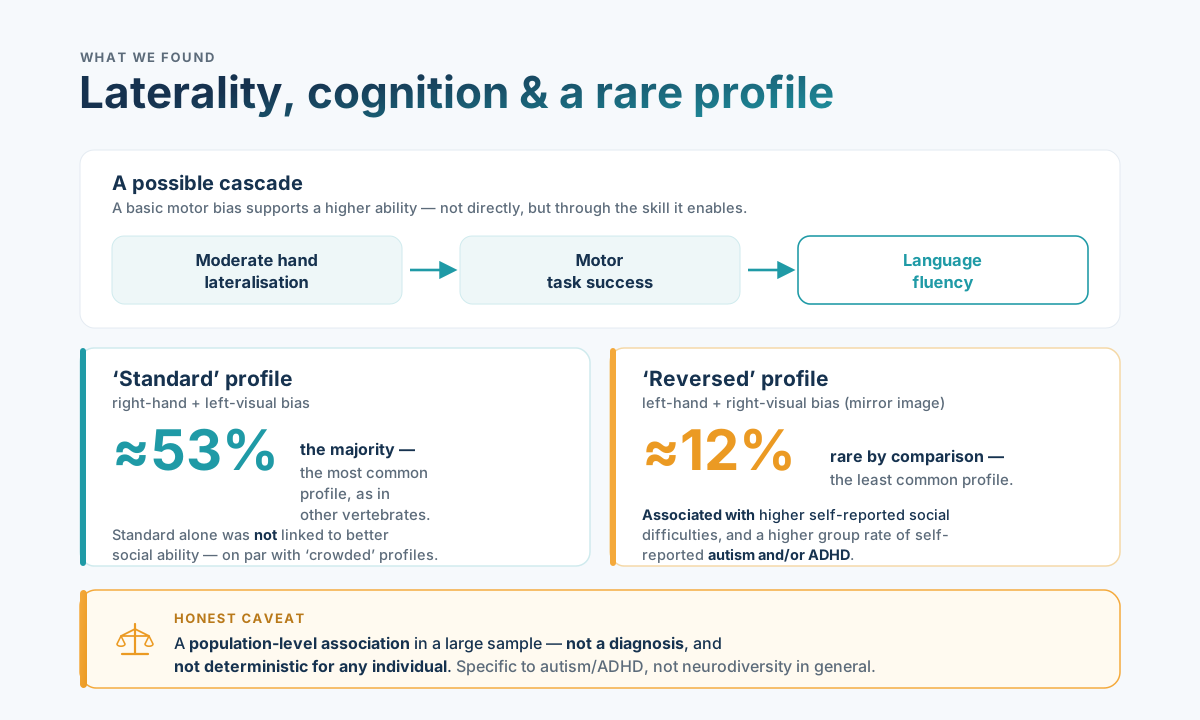
Figure 3. Laterality, cognition, and a rare reversed profile.
Why it matters
The most valuable thing this study does is frame a human question comparatively. By insisting that explanations of human cognition stay consistent with biology and evolution — and by testing the same biases, in the same theoretical terms, that have been studied across the animal kingdom — it turns a scattered, inconsistent human literature into something with structure. The payoff is concrete. The “goldilocks” result helps explain why earlier human studies disagreed about whether lateralisation helps or hurts: if moderate bias is best, then looking only at direction, or only at extremes, would naturally produce mixed answers. The cascade finding offers a developmental story — basic motor biases supporting higher abilities through the skills they build — that can now be tested directly. And the careful, comparative treatment of the reversed profile reframes it not as a deficit but as a difference in alignment, one that may simply carry different social trade-offs, as a minority reversed direction does across many species.
It also shows what becomes possible when a large, diverse behavioural dataset is paired with disciplined analysis. A walk-in museum sample is gloriously messy — uneven group sizes, non-normal distributions, many interacting variables — and findings like the quadratic “goldilocks” effect or a real-but-small group difference only emerge if the statistics are done with care: bootstrapping for robustness, the right covariates, and a refusal to claim more than the numbers support. That last discipline is especially important for the sensitive finding here, which is stated comparatively and at the population level throughout, never as something diagnostic or deterministic for a person.
It is also the kind of question stm.ai exists to help answer. Bringing data-science and quantitative analysis to a study like this is less about running models than about discipline: deciding which patterns are real and which are artefacts of a noisy sample, holding each claim to exactly what the statistics will bear, and stating a sensitive result no more strongly than the evidence allows. A citizen-science effort like Me, Human buys a breadth of human variety that a controlled lab cohort almost never affords — but breadth on its own proves nothing; it is the analysis underneath that decides whether the breadth becomes insight. Handled that carefully, the most ancient blueprint in the brain still has plenty to tell us about how we think, speak and connect.
G. Donati, T. Edginton, A. Bardo, T.L. Kivell, H. Ballieux, C. Stamate, G.S. Forrester — “Motor-sensory biases are associated with cognitive and social abilities in humans”, Scientific Reports 14, 14724 (2024). Read the paper.