Giving deep networks a better starting point
Read the paper →Training a deep neural network is, in large part, a search. The network’s weights are a set of numbers, and learning means nudging those numbers — millions of them — toward values that solve the task. But every search has to begin somewhere, and where it begins turns out to matter enormously: start the weights badly and a deep network can learn slowly, get stuck, or fail to learn at all. This paper asks a deceptively simple question — instead of starting from random numbers, can we choose a principled starting point that gives a deep network a genuine head start?
The problem
Deep learning works by stacking many layers of representation on top of one another, rather than the one or two layers traditional machine learning relied on. That depth is exactly what gives deep networks their power — and exactly what makes them hard to train. Before any learning happens, every connection in the network needs an initial weight, and the standard practice is to draw those weights at random. Weight initialisation is really a parameter-estimation problem: the goal is to pick starting values that sit in a good region of an enormous, high-dimensional search space, close to a good solution rather than trapped near a poor one.
For shallow networks there is an abundance of initialisation techniques to choose from. For deep architectures there is not. As the authors put it, we have many ways to initialise shallow networks but are lacking in techniques for deeper ones — and the heuristics built for one or two layers do not simply carry over when there are many. In very high-dimensional weight spaces the landscape even changes character: the poor local minima that plague shallow networks tend to turn into saddle points, flat regions that can stall training in a different way. The dominant principled approach at the time, normalized initialisation (NI), works well and is robust across activation functions, but the paper notes there were essentially no alternatives to it. That gap — the lack of principled ways to start a deep network — is the problem this work sets out to address.
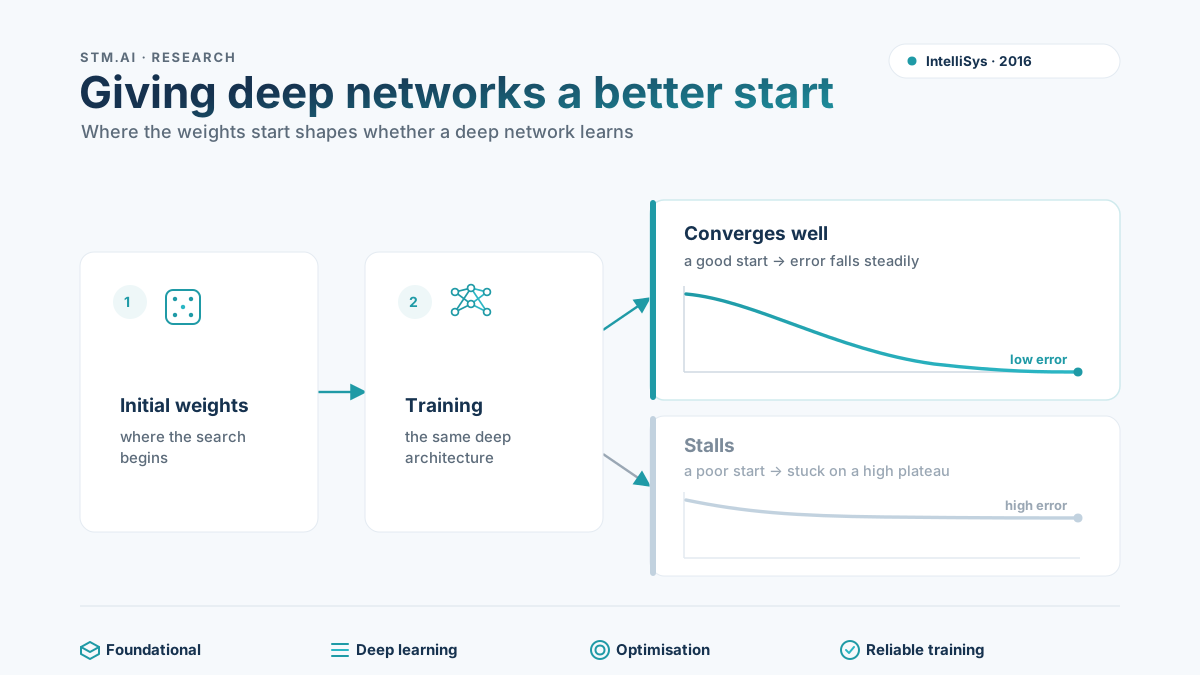
Figure 1. The starting point matters: weight initialisation shapes training.
The idea
The proposal builds on interval analysis, a branch of mathematics developed in the 1960s to reason about uncertainty by working with ranges of values rather than single numbers. The intuition behind the method is physical, not just mathematical. A hidden unit in a network is most useful when the total signal arriving at it lands inside the active region of its activation function — the part of the curve where the unit actually responds and passes information on, rather than saturating flat. If the incoming signal is too large or too small, the unit stops being informative, and across many stacked layers those problems compound until the signal degrades.
So instead of asking “what random weights shall we use?”, the method asks “what range of weights keeps every unit’s incoming signal inside its useful region?” Interval analysis turns that requirement into a linear interval tolerance problem: given the actual data flowing into a layer, it computes bounds on the weights such that the combined input to each hidden node is guaranteed to stay within the activation’s active band. The initial weights are then drawn at random from within those computed bounds rather than from an arbitrary range — random, but constrained to a range chosen so signals propagate cleanly.
The authors call the resulting procedure DLIT (Deep Linear Interval Tolerance). It extends earlier interval-tolerance work on shallow networks — Adam, Karras, Magoulas and Vrahatis (2014) — and adapts it to the depth of modern architectures. DLIT works layer by layer: it reads simple statistics from the input data, uses them to bound and sample the first layer’s weights, passes the data through that layer’s activation to produce the input for the next layer, and repeats — extending the original input-to-hidden recipe with new handling for the hidden-to-hidden and hidden-to-output layers that depth requires. It has a small number of tunable hyper-parameters, including one tied to the curvature of the chosen activation function — straightforward for tanh and logistic, and requiring a search for ReLU, which has no curvature.
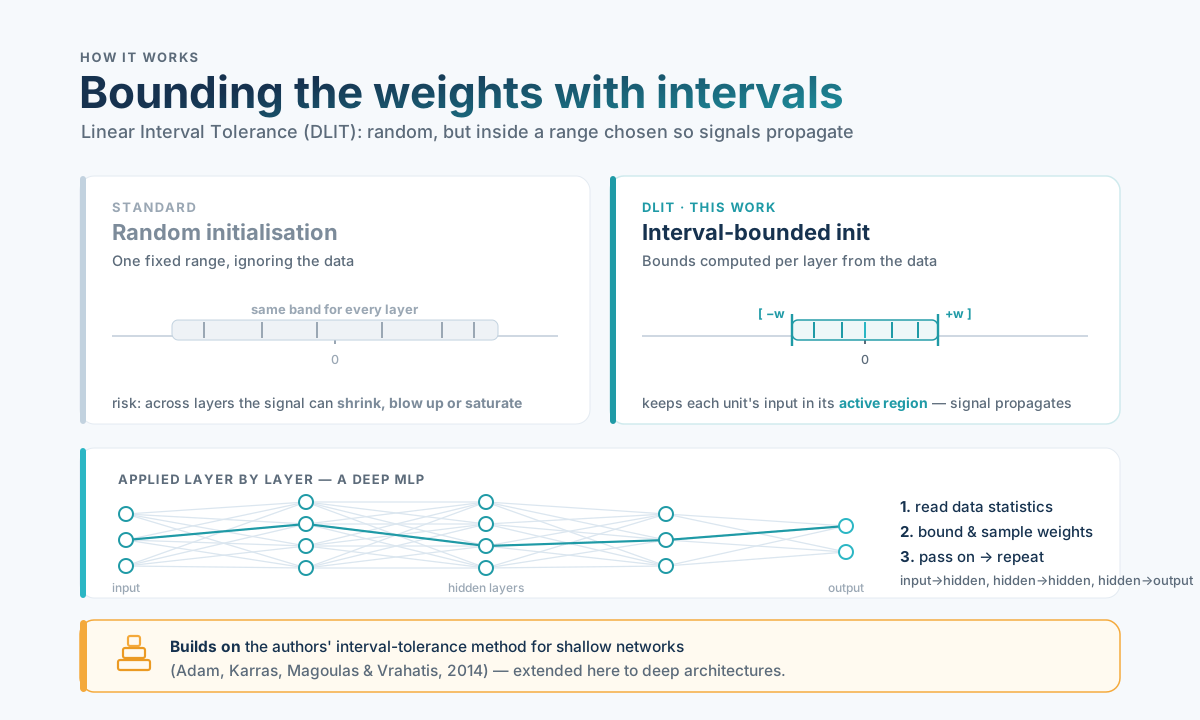
Figure 2. Linear Interval Tolerance initialisation, in brief.
What we found
This is a preliminary empirical study, and the paper is careful to frame it that way. The authors evaluated DLIT on three standard benchmarks from the deep-learning literature — MNIST, CIFAR-10 and CIFAR-100 — chosen precisely because they come with well-known published results to compare against. They tested deep multilayer perceptrons across two activation functions (ReLU and tanh), two mini-batch sizes, and different network shapes — for example a 2000-1000-500 architecture at a mini-batch of 10, and a deeper 3000-2000-1000-500-100 architecture at a mini-batch of 500 — training for 200 epochs with categorical cross-entropy and no early stopping. Throughout, they compared DLIT head-to-head against normalized initialisation (NI) using the same architectures and hyper-parameters for both, so the only thing changing was how the weights started.
The headline is modest and honest: across these settings DLIT produced slightly better generalisation than NI. On the test set, lower cross-entropy error is better, and DLIT came out ahead consistently. With ReLU at a mini-batch of 10, for instance, DLIT reached a test error of 1.57 on MNIST versus 2.13 for NI, 49.33 versus 52.77 on CIFAR-10, and 71.92 versus 73.76 on CIFAR-100. The same pattern held with tanh and at the larger mini-batch size and deeper architecture — DLIT edged out NI across activation functions, mini-batch sizes and topologies, which is what the authors most wanted to see: not a single lucky win, but consistency. Equally important is what did not go wrong. Because they deliberately omitted early stopping, the authors could watch whether layers saturated — froze up and stopped learning — and found that neither NI nor DLIT prematurely saturated nodes. The takeaway is a method that is robust and reliably competitive with the strongest principled baseline of its day, not a dramatic leap in accuracy.

Figure 3. What the preliminary evaluation showed.
Why it matters
The starting point is one of the quiet levers behind everything a deep network goes on to do. A better-initialised network trains faster, wastes less computation, and is less likely to stall — and because the gains come before a single training step, they cost almost nothing at run time. That is why initialisation has remained a live question in deep learning long after the headline architectures grab the attention: it is foundational plumbing, and foundational plumbing is what every applied result quietly stands on.
This paper should be read for exactly what it is — an early-stage method, demonstrated in a preliminary study on public benchmarks, presenting a promising direction rather than a finished, definitive result. The authors are explicit about the road ahead, proposing in particular to hybridise DLIT with normalized initialisation for stability in even higher-dimensional weight spaces, and to fold the method’s tunable parameters into a more automatic, generalised version. What it signals about stm.ai is the depth of the foundation: this is fundamental work on optimisation and deep-network training, the kind that sits beneath applied AI. The same rigour with how learning systems are built — principled where others reach for defaults, honest about the gap between a promising method and a proven one — runs through the company’s applied work in MedTech and FinTech.
C. Stamate, G.D. Magoulas, M.S.C. Thomas — “Initialising Deep Neural Networks: An Approach Based on Linear Interval Tolerance”, in Proceedings of SAI Intelligent Systems Conference (IntelliSys) 2016, Springer, Lecture Notes in Networks and Systems (2016). Read the paper.